

How much explainability are we willing to trade for predictive power?
Consider four approaches to credit risk modelling.
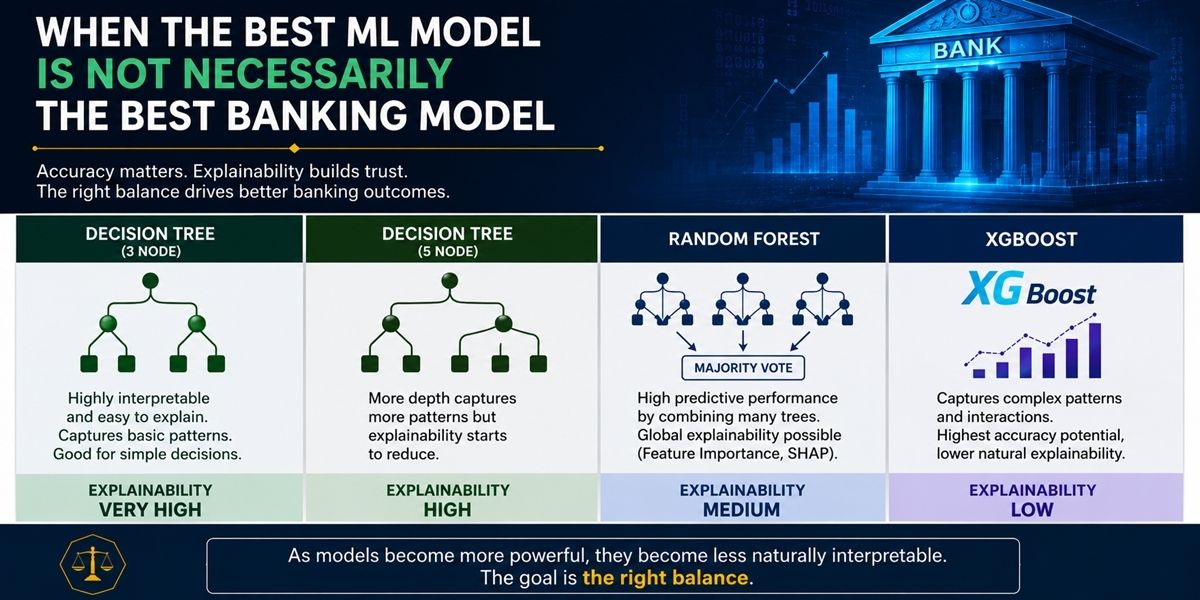
A simple decision tree with three levels is highly transparent. You can almost explain the decision by walking through the branches. Increase the complexity to five levels and the model can capture more patterns, but starts becoming harder.
Random Forest improves predictive capability by combining many decision trees. The individual decision path is no longer as straightforward, but feature importance and SHAP can help explain the model’s behaviour.
XGBoost can capture complex nonlinear relationships and interactions and often delivers stronger predictive performance than simpler models. But the price is greater model complexity. The model may be highly effective without being naturally intuitive to a business user.
And then there is Logistic Regression, which remains extremely relevant in banking because the relationship between variables and the outcome can be explained through coefficients, direction and statistical significance.
This creates an interesting spectrum:
Simple Decision Tree → Logistic Regression → Random Forest → XGBoost
As predictive sophistication increases, natural explainability generally becomes more difficult. But that does not mean banks should automatically choose the simplest model. Nor should they automatically choose the most accurate model.
The real focus is:
Can we build a model that delivers the required predictive performance while still providing a credible explanation for every material decision?
That is where Explainable AI, particularly SHAP based explanations, becomes important. It can provide both a global view of what drives the model and a local explanation of why a particular applicant received a particular prediction. Recent credit scoring research continues to demonstrate this accuracy versus interpretability trade off.
For a bank, however, explainability is more than a technical feature. It connects directly to model validation, governance, fairness, customer communication and accountability.
The future of AI enabled lending therefore may not belong to the model with the highest AUC. It may belong to the institution that can achieve the right balance between:
Predictive Power + Explainability + Governance + Business Outcomes
That is where AI becomes truly usable in banking.
What would you choose for a lending decision: the most accurate model, the most explainable model, or the best balance between the two?
– Sitaraman Raghavasubramanian