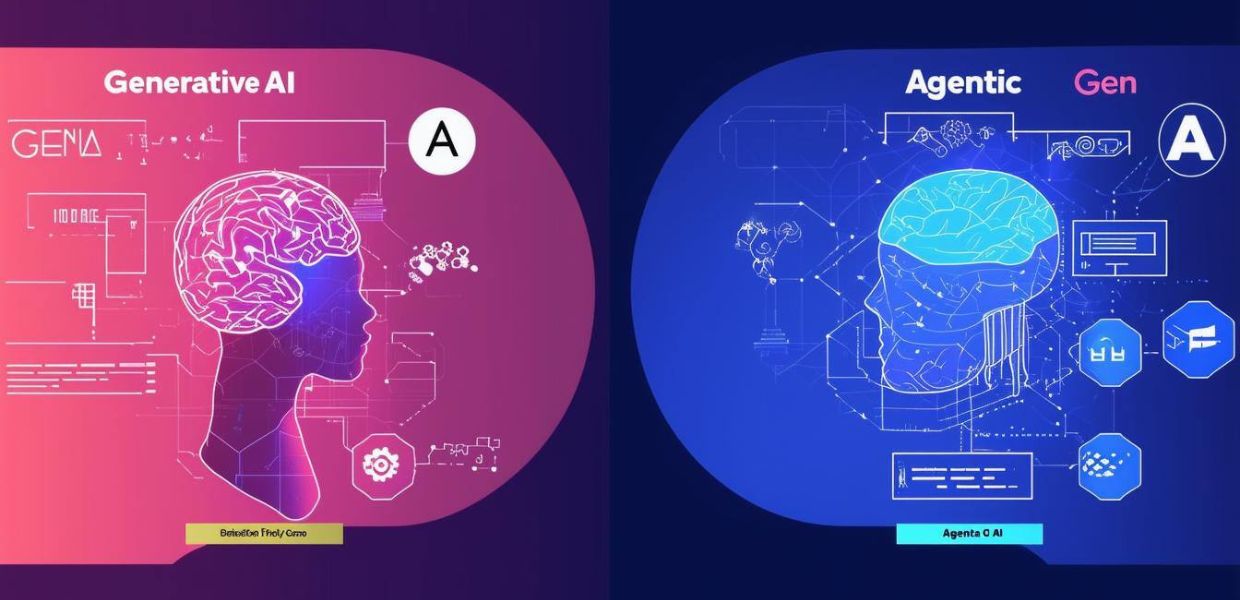
Artificial Intelligence has been rapidly evolving from systems that generate outputs to systems that can reason, decide, execute, and collaborate autonomously using the data analytics and training.
Two major paradigms currently shaping enterprise transformation are:
- Generative AI (GenAI)
- Agentic AI
While both are interconnected, they serve fundamentally different business purposes.
- What is Generative AI?
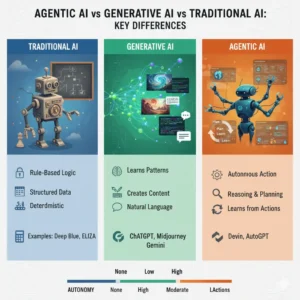
Generative AI refers to AI systems designed primarily to create content, insights, or responses based on prompts and patterns learned from large datasets.
These systems are highly effective in: Content generation, Summarization, Code generation, Conversational support, Data interpretation, Knowledge assistance.
Examples – Open AI ChatGPT, Google Gemini, Microsoft Copilot, Anthropic Claude
Core Nature
Generative AI is primarily: Reactive, Prompt-driven, Output oriented, Human-guided. It generates intelligence when asked.
- What is Agentic AI?
Agentic AI refers to AI systems capable of: Planning, Reasoning, Decision-making, Taking actions, Executing multi-step tasks autonomously, Interacting with systems, tools, APIs, workflows, and even other agents
Agentic AI behaves more like a: Digital Employee, Autonomous Assistant
Core Nature
Agentic AI is: Goal Driven, Autonomous, Context-aware, Multi-step reasoning capable, Action Oriented. It does not merely respond. It can initiate, evaluate, adapt, and execute. These Agents are created for a specific business purpose.
BFSI Industry Perspective
In Banking, Financial Services, and Insurance (BFSI), the distinction becomes strategically significant.
Few Probable Generative AI Use Cases in BFSI
Customer Communication Drafting, Regulatory Summarization, Credit Note Generation, Knowledge Management, Training Content Creation
Agentic AI Use Cases in BFSI
Autonomous Fraud Monitoring, Dynamic Risk Assessment in Financial Crime Control, AI driven underwriting workflows, Intelligent Compliance Monitoring, Customer onboarding orchestration, Multi System Reconciliation
Leadership Implications
Generative AI Changes:
How employees work, Speed of productivity, Knowledge accessibility, Content creation efficiency
Agentic AI Changes:
How organizations operate, Decision Architecture, Workforce Structures, Governance Models, Accountability Frameworks
This shift moves enterprises from: AI as a Tool to AI as an operational participant.
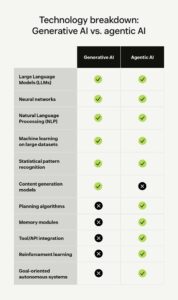
Technology Architecture Difference
Generative AI Stack
Typically includes: Large Language Models (LLMs), Prompt Engineering, Retrieval Systems, Knowledge Bases (KB)
Agentic AI Stack
Includes: LLMs, Planning Engines, Memory Systems, Tool Integrations, API Orchestration, Monitoring Layers, Feedback Mechanisms. In summary, Agentic AI is : Generative AI + Reasoning + Memory + Action + Autonomy
Future Outlook
The future will likely not be: Human vs AI. Instead, it is becoming: Humans + Generative AI + Agentic AI Ecosystems. Organizations that succeed will combine: Human Judgment, AI Augmentation, Autonomous Orchestration, Ethical Governance, Continuous Learning Cultures
Conclusion
Generative AI is the beginning of intelligent augmentation. Agentic AI is the beginning of intelligent autonomy. Generative AI helps people work smarter. Agentic AI helps enterprises operate smarter.